Real-Time Job and Materials Tracking and Control
in a Distributed Manufacturing Enterprise
A White Paper by Dr. Peter Green
Abstract
Manufacturing enterprises operating multiple plants and warehouses increasingly need near-real-time visibility into jobs, materials, and operational
status across all locations. Centralized cloud-based ERP systems simplify IT management,
but they can introduce reliability, response-time, and equipment-integration problems when many workers at multiple sites
depend on the same remote system for barcode scanning, RFID, process control, and operational decision-making.
These limitations become particularly significant when Internet connectivity or the central data center is unavailable.
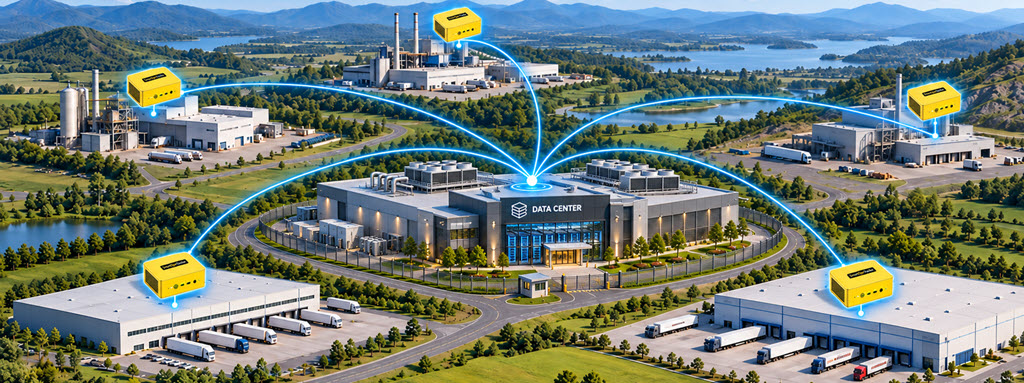
This paper examines a distributed computing alternative in which each plant or warehouse uses a local Internet of Things (IOT) computer
for real-time job and materials tracking, while exchanging orders and status data with a central enterprise database
through encrypted store-and-forward communications. This architecture allows local operations to continue during Internet outages,
improves barcode-scanning response times, simplifies integration with local RFID and process-control equipment, and provides
enterprise-wide operational visibility, although at the cost of greater initial IT complexity.
Key Take-Away Points
- Real-time operational data is essential for distributed manufacturing. Central planning and AI-based scheduling depend on current
information about jobs, materials, and inventory at each plant and warehouse; day-old ERP data can produce poor schedules and require manual correction.
- Centralized cloud systems create a single operational dependency. If Internet connectivity or the central data center fails, multiple plants
and warehouses can lose access to the systems needed to control and track operations.
- Shop-floor systems require very fast response. Barcode and RFID transactions should typically receive feedback within one or two seconds,
making latency and contention in a shared central server a significant issue for larger multi-site operations.
- A distributed Internet of Things (IoT) architecture improves resilience and local performance. Local job and materials tracking systems can continue
operating during Internet outages, provide rapid barcode response, support real-time mistake checking,
and integrate directly with RFID, barcode printers, scales, and other plant equipment.
- There is no single best architecture; the trade-off changes with scale.
Cloud-based ERP can be appropriate for small, independently operating plants, but as an enterprise expands to multiple
geographically separated plants and warehouses, the balance increasingly favors a distributed computing approach despite greater initial IT complexity.
Please click here to download the PDF of
Real-Time Job and Materials Tracking and Control in a Distributed Manufacturing Enterprise.