|
|

|
|
|
|
|
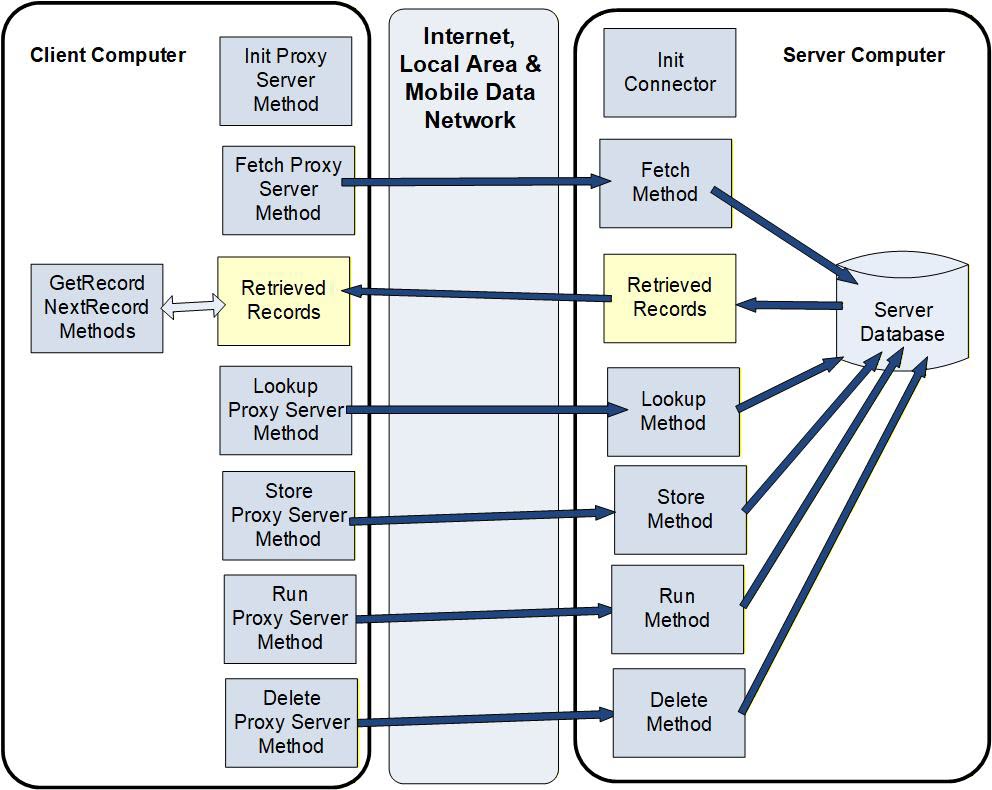
WIPtracker, SmartOps24x7, iMTATs, BellHawk, and MilramX all provide remote access to their databases by means of a secure, encrypted SOAP/XLM interface. This interface used the same six methods, which are based on the use of Tau Adaptor HLDOs and database adaptors.
These interfaces have a defined WSDL (Web Services Description Language) definition from which it is possible to generate the proxy routines, using WCF (Windows Communications Foundation) using a tool such as Visual Studio. Alternately, if Python is being used on an external system the zeep library (https://pypi.org/project/zeep/) can be used to securely exchange data with the databases over the Internet, or local area network, or the mobile data network.
The code inside the common web-services handlers are designed to be reasonably robust against intermittent disconnections between the client and server computers. This is critical given the unreliability of today's Internet. But, it is important to structure the client-side code to allow for such intermittent disconnections and occasional loss of transmitted data both to and from the server computer.
With appropriate client-size code, such as that in the web-services database pseudo adaptors, which can be used for communications between different SmartOps packages, it is possible to construct robust store-and-forward mechanisms. These mechanisms enable client computers to operate independently for long periods and then to exchange data automatically when communications is available.
Please note that the Tau Adaptor libraries do not directly provide REST interfaces as these are best handled by MilramX Intelligent Agent Agent (IAP) processes written in Python.
Please click here to see how the different Tau Adaptor libraries interact with each other.
| TauAdaptor | HLDOs | Sample Code | Adaptors | Web Services |
Copyright © SmartOpsMgt LLC 2026